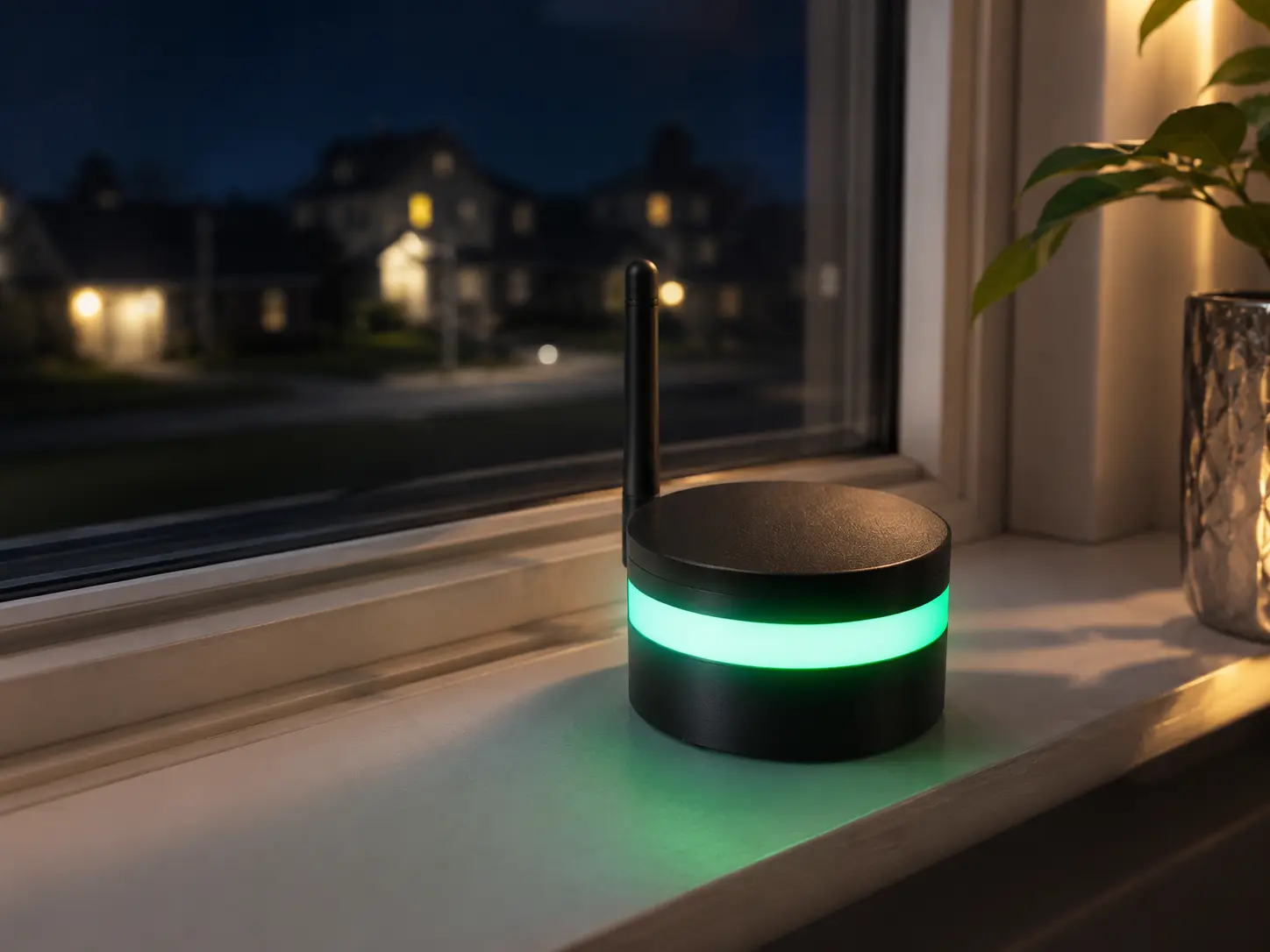
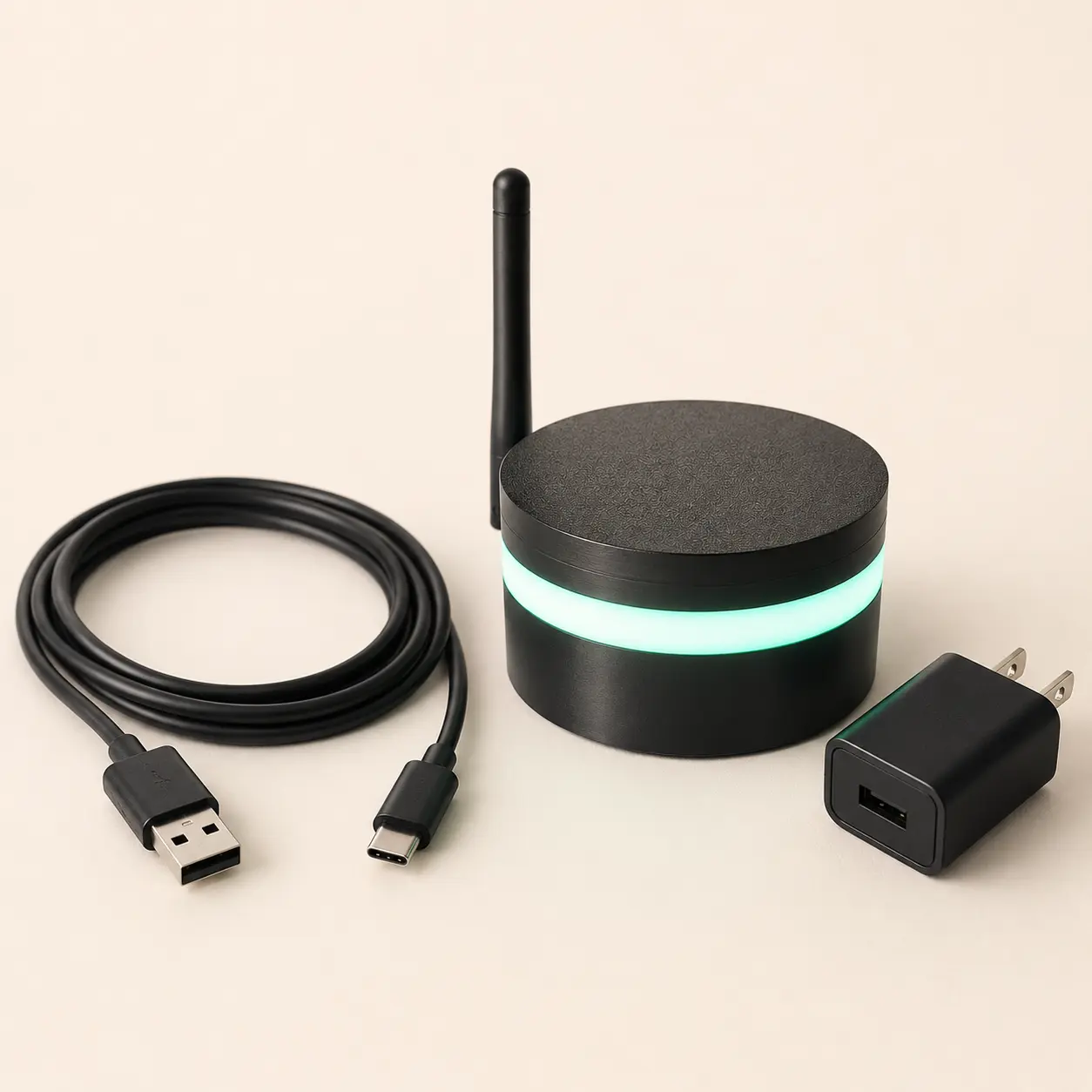
WiSpyAlert senses the wireless devices people carry — and reacts the moment an unknown one approaches your home. Light on. Alert sent. Before anyone touches the door, and without you lifting a finger.
No cameras. / No video. / No app to check. / Your house responds by itself.
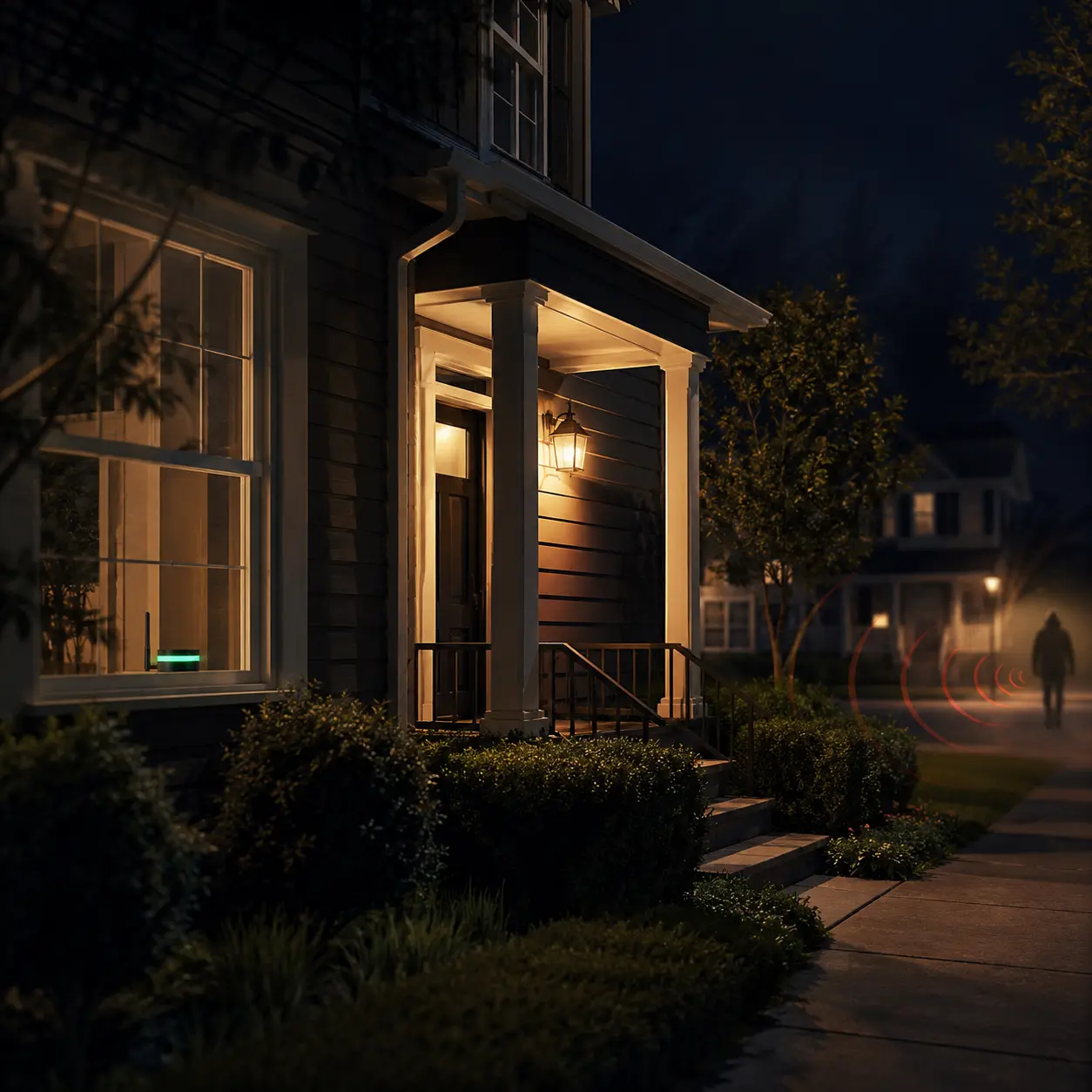
Cameras record the event. Motion lights trip when someone's already on your lawn. Doorbell alerts arrive while you're asleep, in a meeting, on a plane. Every tool you own reports to you — and assumes you're awake, watching, and ready to respond. At 3 AM, nobody is.
The fix isn't a better alert. It's a house that doesn't need you to respond.
No faces. / No video. / No identities. / Just signal patterns your house can act on.
WiSpyAlert passively senses wireless activity — WiFi and Bluetooth signals from phones, watches, earbuds, anything radiating. It learns what's normal for your home, flags what isn't, and responds on its own.
WiSpyAlert sits in a front window and passively scans the RF environment. Over the first day it builds a baseline: your family's devices, the neighbor's smart TV, the regular delivery cadence. Nothing leaves your network during learning.
After learning, anything that doesn't match the baseline and shows an approach pattern — signal getting stronger over time — is flagged. Known devices, passing traffic, and the ambient neighborhood hum are ignored. A calibration tool lets you tune sensitivity to your street.
The moment an unknown approach is flagged, WiSpyAlert flips a Wiz bulb on — local network, milliseconds, no cloud handoff — and logs the event to your dashboard. Your home looks awake before anyone reaches the door. Sleep through it. Review it with coffee.
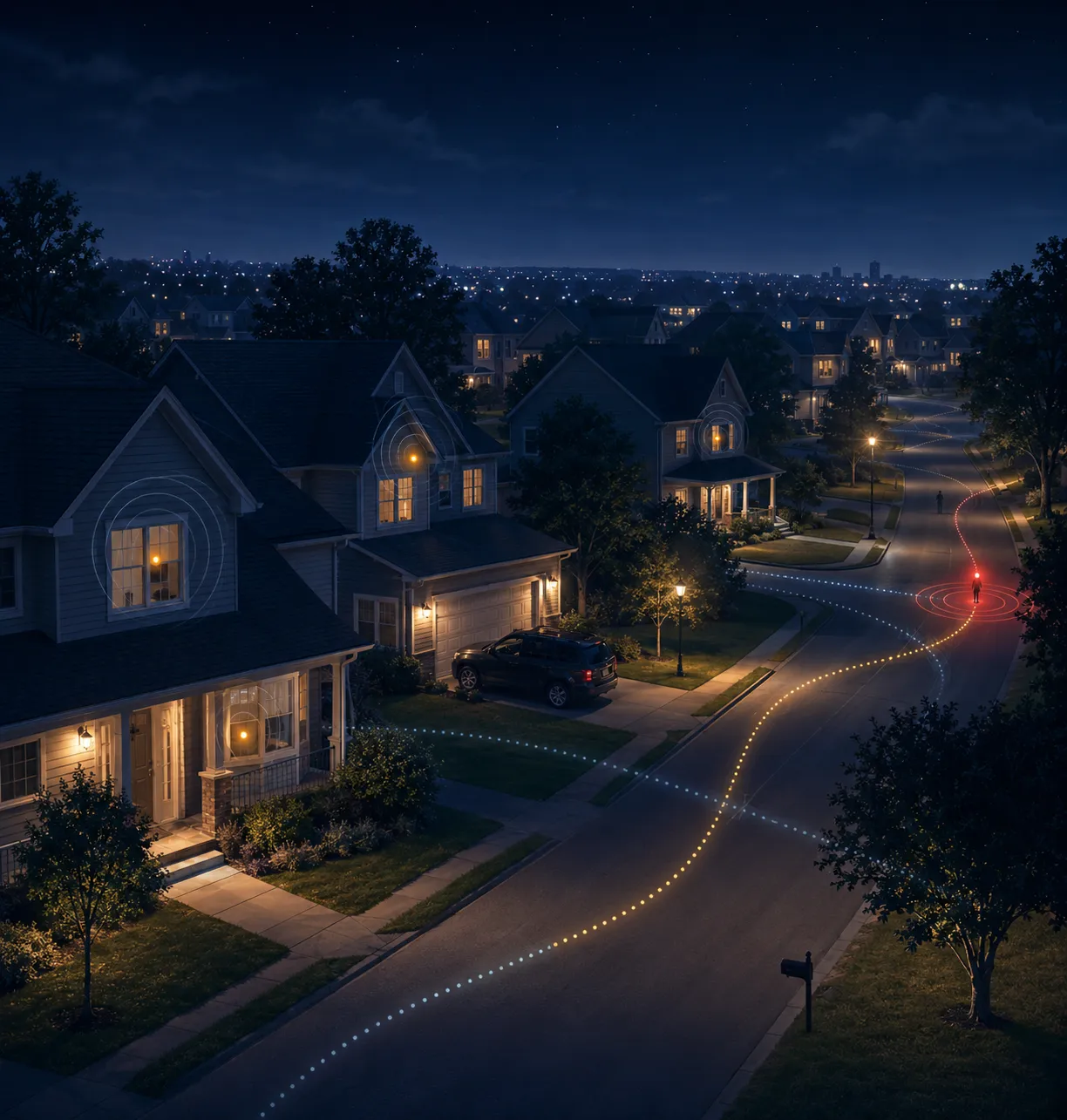
Your sensor protects your home on day one — that part needs nobody else. But when neighbors add sensors, anonymized detections combine into a block-level picture: the same unknown signal moving house to house becomes a mapped route instead of an isolated blip. One sensor defends a home. Several start to see the street.
No identities are ever shared — just events: unknown signal, this pattern, this time. How the network works →
The industry is moving toward camera-free ambient sensing. In February 2026, ADT acquired Origin AI for $170 million — picking up more than 200 patents in WiFi-based sensing — with products expected in 2027. You can have the earlier layer now: not what's happening inside your home, but what's approaching it.
The sensor and the automatic light response work out of the box, locally, forever — no subscription required. The monthly plan adds the cloud dashboard, remote alerts, event history, and the neighborhood layer as it grows in your area.
No cameras means no faces. No identities means no owners. What's left is the technical metadata of an event — a signal, a time, a pattern. Below: representative records. Every field present is something the system uses. Every field absent is something it doesn't.
No. WiSpyAlert detects that a device is approaching, not which device. Modern phones randomize their MAC addresses constantly — that's exactly what makes the approach-pattern method work without tracking identities. There are no cameras. No video. No facial recognition. No identity data collected. Just events: unknown signal, this pattern, this time.
During the 24-hour learning window, your sensor profiles every device that normally exists in your RF environment — your devices, your family's, your neighbors' constant signals, regular delivery patterns. After learning, anything that doesn't match that baseline and shows an approach pattern (signal getting stronger over time) is flagged as unknown. The calibration tool lets you tune sensitivity.
No. Local detection and the automatic Wiz light response work out of the box with no subscription, forever. The $7.95/month adds the cloud dashboard — remote alerts, event history, settings from anywhere — plus the neighborhood detection layer as it grows in your area.
Direct local UDP control. WiSpyAlert can flip a Wiz bulb on in milliseconds without going through any cloud service or third-party app. Other smart bulbs need IFTTT or Home Assistant as a middleman — slower, more brittle, more accounts to manage. Wiz bulbs work because they happen to expose a simple local protocol.
No. It's an earlier layer. Your cameras catch what happens at the door. Your alarm responds to breach. WiSpyAlert responds to what's approaching — often before anyone reaches the door, and without needing you awake. The three together work better than any one alone.
An optional bonus layer. When neighbors also run sensors, anonymized detection events combine into a block-level picture — the same unknown signal moving house to house becomes a mapped route. Your sensor protects your home fully on its own; the network is what several sensors near each other unlock. Coverage is early and grows as sensors come online. Details here.
30-day money-back guarantee, no questions. Send the device back, get a full refund of the hardware cost, subscription cancels automatically.
One sensor in a front window. Twenty-four hours of learning. Then a home that responds to what approaches it — whether you're asleep, away, or just done checking apps.
Order Now — $49.95 + $7.95/mo